The Volcano That Starved Egypt
This post contains affiliate links. If you purchase through them, I may earn a small commission at no extra cost to you.
In 1783, a crack opened in the earth in southern Iceland. It didn't explode upward like Vesuvius or Krakatoa. It oozed. Lava poured from a 27-kilometer fissure in the ground for eight straight months, releasing more sulfur dioxide than any eruption in recorded history.
The Laki eruption, as it came to be called, killed a quarter of Iceland's population. That part makes it into the history books. But what happened next—what the eruption did to countries that had never heard of Iceland—is a story that reshapes how we think about connection, vulnerability, and the invisible threads that hold civilizations together.
The Poison Cloud
Laki didn't just produce lava. It ejected roughly 120 million tons of sulfur dioxide into the atmosphere—a toxic haze that drifted southeast across Europe within days.
In June 1783, the English naturalist Gilbert White recorded a "peculiar haze" that dimmed the sun and smelled of sulfur. Benjamin Franklin, stationed in Paris as American ambassador, noted the same thing. He was one of the first to connect the haze to volcanic activity, writing that the "dry fog" had probably originated from "the volcano in Iceland."
Franklin was right, but the scale of what was happening exceeded what any single observer could grasp. The sulfur dioxide formed sulfuric acid aerosols in the upper atmosphere, creating a reflective layer that blocked solar radiation from reaching the ground.
Europe's summer of 1783 was brutally hot—the aerosols trapped existing heat while the haze created a greenhouse effect at lower altitudes. Then winter arrived, and temperatures plunged. The following years, 1784 and 1785, saw some of the coldest winters in European history.
Crop failures cascaded across the continent. In France, the price of bread doubled.
The Nile Didn't Rise
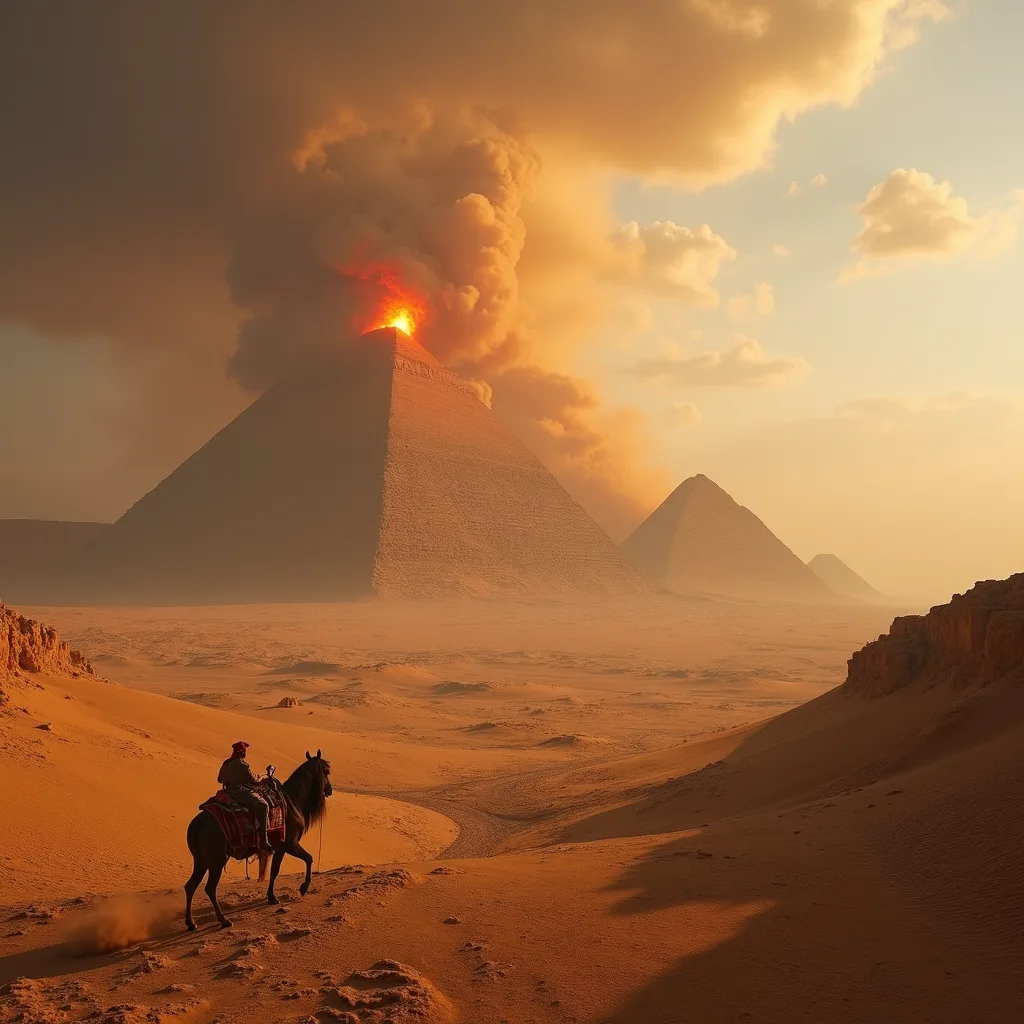
Egypt's civilization had depended on the Nile's annual flood for five thousand years. Every summer, monsoon rains in the Ethiopian highlands fed the Blue Nile, which surged northward, overflowing its banks and depositing rich silt across the floodplain. Egyptian farmers planted in the mud the flood left behind. The entire agricultural system—and therefore the entire economy, and therefore the entire political structure—rested on that flood arriving on time and at sufficient volume.
In 1783, the Nile didn't rise.
The volcanic aerosols from Laki disrupted the African and Indian monsoon systems. The temperature differential that drives monsoon circulation—warm land pulling moist air from the ocean—was reduced by the cooling effect of the sulfur haze. Less monsoon rain fell over Ethiopia. The Blue Nile ran low.
The flood that Egyptian farmers had counted on since the time of the pharaohs simply didn't happen. And then it barely happened the following year. And the year after that, it was weak again.
The result was famine on a scale that Egypt hadn't seen in centuries.
The Famine of 1784
Contemporary accounts from Egypt describe scenes that are difficult to read. The French consul in Cairo, Charles Magallon, reported that people were eating grass, leather, and the bark of trees. Dogs and cats vanished from the streets—first eaten, then simply absent. The price of grain rose to levels that made it unaffordable for anyone but the wealthy.
The Mamluk rulers of Egypt—a military caste that had governed since 1250—found themselves unable to collect taxes from farmers who had nothing. Their power structure, which depended on agricultural surplus, began to crack. Soldiers went unpaid. Provincial governors stopped answering to Cairo.
Estimates suggest that roughly one-sixth of Egypt's population died in the famine of 1784-1785. In a country of approximately 4 million people, that's over 600,000 deaths—all traceable, through a chain of atmospheric chemistry and monsoon disruption, to a crack in the ground in Iceland.
The Egyptians, of course, had no idea. They attributed the Nile's failure to divine displeasure, political corruption, or the usual culprits of pre-scientific explanation. The connection between an Icelandic volcano and an Egyptian famine wouldn't be established for another two hundred years.
The French Connection
The same atmospheric disruption that starved Egypt was simultaneously destabilizing France. The crop failures of 1783-1788 created bread shortages that pushed the French peasantry to the breaking point.
Historians have long debated the causes of the French Revolution. Economic inequality. Enlightenment philosophy. Royal extravagance. Political dysfunction. All of these played roles. But the trigger—the thing that turned simmering resentment into actual revolt—was bread.
When bread prices doubled and then tripled, people who had tolerated inequality for generations suddenly couldn't feed their families. The famous (and probably apocryphal) "let them eat cake" captured a real dynamic: the ruling class seemed indifferent to a crisis that was killing the poor.
The storming of the Bastille happened in July 1789—six years after Laki erupted. That sounds like a long gap, but atmospheric disruptions from major eruptions persist for years. The crop failures compounded. Each bad harvest made the next one harder to survive, because reserves were depleted and prices were already inflated.
This isn't to say that a volcano caused the French Revolution. That would be absurdly reductive. But it's equally absurd to analyze the revolution without acknowledging that a volcanic eruption in Iceland created the food crisis that made revolution possible.
The Invisible Web
The Laki story reveals something that we're still struggling to internalize: the world has always been connected. Not connected in the modern sense—instant communication, global supply chains, social media. Connected in a deeper, more fundamental sense: through atmosphere, through ocean currents, through the movement of air and water and particles that don't respect borders.
An Icelandic volcano affects Ethiopian monsoons. Ethiopian monsoons determine Egyptian agriculture. Egyptian agriculture sustains Mamluk political power. The same volcano affects French wheat harvests. French wheat harvests determine whether a revolution happens.
None of these connections were visible to the people experiencing them. The Egyptian farmer didn't know about Laki. The French baker didn't know about the monsoon disruption. Each experienced their crisis as local, specific, and explicable in local terms.
We do the same thing today. We experience events as isolated—a supply chain disruption here, a drought there, a political upheaval somewhere else—without seeing the atmospheric, economic, and ecological threads that connect them. We've gotten better at tracking these connections scientifically, but we're still remarkably bad at incorporating that knowledge into how we plan and govern.
Volcanoes as History Makers
Laki isn't an anomaly. Volcanic eruptions have repeatedly altered the course of human history in ways that most people never learn about.
The eruption of Mount Tambora in 1815 created the "Year Without a Summer" in 1816. Mary Shelley, trapped indoors by unseasonable cold and rain at Lake Geneva, wrote Frankenstein. The crop failures caused widespread famine and emigration from Europe. The invention of the bicycle is sometimes traced to the horse deaths caused by Tambora's crop failures—no feed for horses meant people needed another way to get around.
The eruption of an unidentified volcano around 536 AD created the worst year in human history, according to medieval scholar Michael McCormick. Temperatures dropped, crops failed across the Northern Hemisphere, and the Justinian Plague—the first major outbreak of bubonic plague in Europe—may have been facilitated by the weakened, malnourished population.
Even the fall of the Roman Republic has volcanic connections. Research published in the 2020s linked the eruption of Alaska's Okmok volcano in 43 BC to the unusually cold, wet conditions that caused crop failures around the Mediterranean—conditions that exacerbated the political instability following Caesar's assassination.
What We Still Don't See
The lesson of Laki isn't really about volcanoes. It's about the limits of human perception.
We're remarkably good at understanding local cause and effect. If the river floods, the crops die. If the crops die, people starve. If people starve, governments fall. We can trace these chains within a single region without difficulty.
But we're remarkably bad at tracing cause and effect across systems. The idea that an event in one part of the world can cascade through atmospheric chemistry, ocean circulation, monsoon patterns, and agricultural systems to cause a famine in a completely different civilization—that kind of thinking doesn't come naturally.
It didn't come naturally in 1783, and it barely comes naturally now. We still build our understanding of the world in compartments: this is a weather event, that is an economic crisis, this other thing is political instability. The connections between them—the Laki-to-Nile-to-famine chains—remain largely invisible in public discourse.
Climate scientists have been trying to communicate this for decades. Not just that temperatures are rising, but that the consequences cascade in ways that are fundamentally unpredictable. A disruption in one system triggers disruptions in others, which trigger disruptions in still others, creating outcomes that no single-variable model can forecast.
Laki taught this lesson in 1783. We're still learning it.
The Most Connected Place on Earth
Iceland sits on the Mid-Atlantic Ridge, the seam where two tectonic plates are pulling apart. It's one of the most volcanically active places on Earth, and it's located precisely where atmospheric circulation patterns can carry volcanic emissions across the entire Northern Hemisphere within weeks.
It's a small island with a tiny population, and it has repeatedly altered the fate of civilizations that most of its inhabitants had never heard of. The eruptions didn't care about borders, languages, religions, or politics. They changed the atmosphere, and the atmosphere changed everything else.
We tend to think of connection as something humans create—roads, trade routes, telegraph wires, internet cables. But the deepest connections are the ones that exist whether we build them or not. The atmosphere connects every human on Earth to every other human on Earth. It always has. The only question is whether we notice before the next Laki reminds us.