The Library That Burned Three Times
This post contains affiliate links. If you purchase through them, I may earn a small commission at no extra cost to you.
Ask anyone how the Library of Alexandria was destroyed, and you'll get a confident answer. Julius Caesar burned it during the siege of 48 BC. Or Arab conquerors destroyed it in 642 AD. Or angry Christian mobs torched it in 391 AD.
All of these stories are dramatic. All of them are satisfying. And all of them are, at best, incomplete.
The real story is far more unsettling. Because the greatest library the ancient world ever built didn't die in a single catastrophic moment. It died the way most great things die: slowly, through a combination of neglect, defunding, political indifference, and the gradual erosion of the culture that created it.
The fires were real. But they were symptoms, not causes.
What the Library Actually Was
First, let's understand what we lost.
The Library of Alexandria wasn't a library in any sense we'd recognize today. It was a research institution—closer to a combination of MIT, the Smithsonian, and the Library of Congress. Founded around 295 BC under Ptolemy I, it was part of the Mouseion (the origin of our word "museum"), a temple dedicated to the Muses that functioned as a state-funded center of scholarship.
Scholars lived there, rent-free, with meals provided, exempt from taxes. Their only obligation was to think, write, teach, and advance human knowledge. The Ptolemies understood something that most governments struggle with today: intellectual capital requires investment without immediate return.
At its peak, the library held an estimated 400,000 to 700,000 scrolls. To put that in perspective: a single scroll might contain one book of Homer's Iliad. The complete Iliad was 24 scrolls. So 400,000 scrolls represented something like 100,000 modern books—a staggering collection for a world where every text was copied by hand.
The acquisition strategy was legendary and ruthless. Ships arriving in Alexandria's harbor were searched. Any scrolls found on board were confiscated, copied, and the copies were returned to the owners. The originals stayed in the library. Ptolemy III reportedly borrowed the original manuscripts of Aeschylus, Sophocles, and Euripides from Athens, putting up an enormous deposit as guarantee of return. He kept the originals. Athens got copies. He forfeited the deposit. He considered it a bargain.
This was knowledge as power. And for nearly three centuries, it worked.
The First Fire: Caesar's War
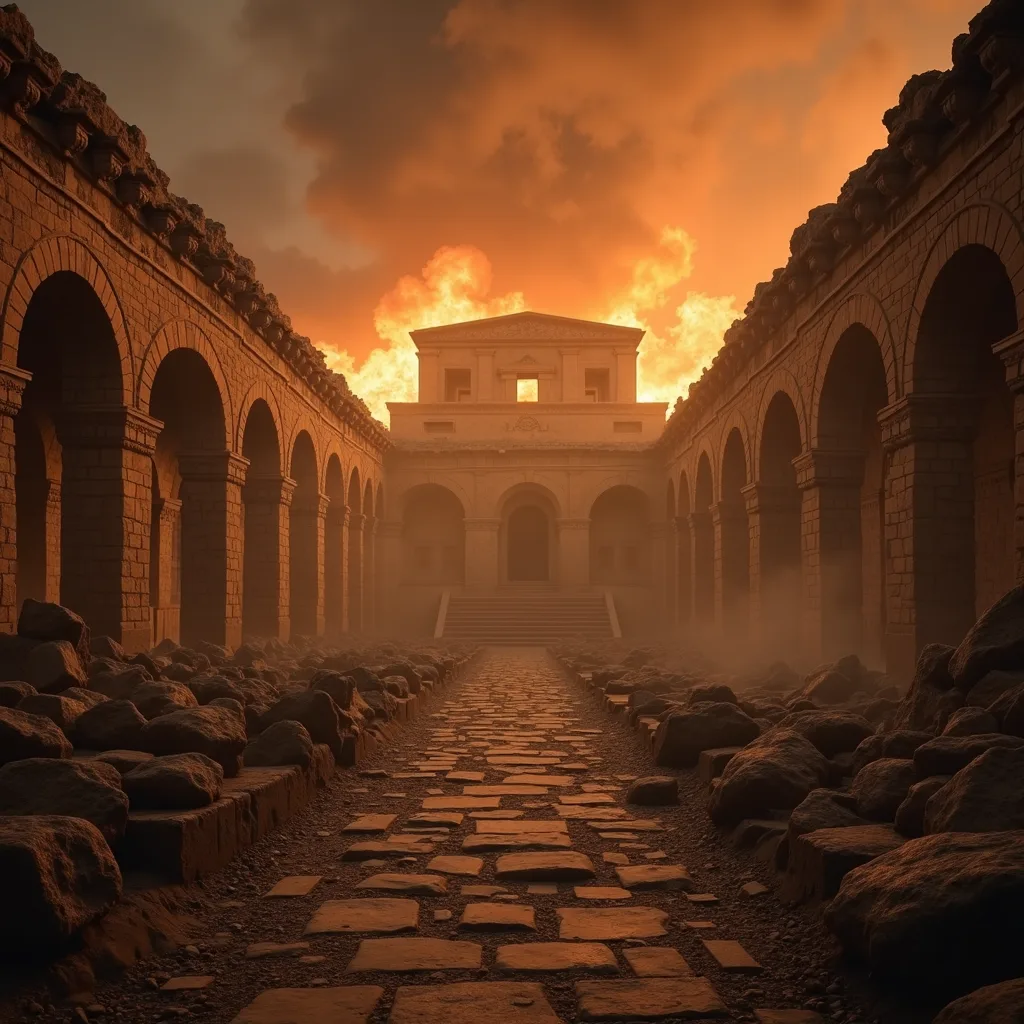
In 48 BC, Julius Caesar was besieged in Alexandria during a civil conflict involving Cleopatra and her brother Ptolemy XIII. Outnumbered and trapped near the harbor, Caesar ordered his men to set fire to the Egyptian fleet to prevent it from being used against him.
The fire spread to the docks. Warehouses burned. And according to several ancient sources, scrolls stored near the harbor were destroyed.
But here's what's often missed: the scrolls near the harbor were almost certainly not the main library collection. They were likely copies prepared for export—Alexandria was the ancient world's largest book-trade hub. The main library, located in the Brucheion royal quarter further from the harbor, probably survived Caesar's fire largely intact.
Plutarch mentions 400,000 scrolls destroyed. Other sources give different numbers. The confusion itself tells us something: even ancient historians weren't sure what happened. What's clear is that Caesar's fire damaged Alexandria's book infrastructure, but it wasn't the death blow. Scholars continued working in Alexandria for centuries afterward. The Mouseion continued to function. The knowledge machine kept running.
Diminished, yes. Destroyed, no.
The Slow Bleeding
What happened next is the part historians find most instructive—and most depressing.
The Ptolemaic dynasty, which had founded and funded the library, ended with Cleopatra's death in 30 BC. Egypt became a Roman province. And the new rulers had different priorities.
Rome valued Alexandria as a grain supplier, not as an intellectual center. Funding for the Mouseion didn't disappear overnight—it eroded. Slowly. The tax exemptions for scholars were reduced, then eliminated. The stipends shrank. The acquisitions budget—the engine that had built the collection—was gutted.
Scholars began to leave. Not dramatically, not in protest. They just... went where the funding was. To Rome. To Antioch. To wherever the next patron was willing to pay for their work. The brain drain was gradual and silent.
This is the pattern that should frighten us most. Not the dramatic fire, but the quiet defunding. The slow realization that the institution's patrons had decided it wasn't worth maintaining. The library didn't burn. It starved.
The Second Crisis: Aurelian's Campaign
In 272 AD, the Roman emperor Aurelian besieged Alexandria to recapture it from the breakaway Palmyrene Empire. The fighting was intense, particularly in the Brucheion quarter—exactly where the main library was located.
Ancient sources describe massive destruction in the Brucheion. Buildings were razed. The district never fully recovered. Whatever remained of the original library collection after three centuries of declining support was likely damaged or scattered during this campaign.
But by 272 AD, the library's importance had already diminished. The intellectual center of gravity had shifted. The collection, once the world's largest, had been shrinking for two hundred years through neglect, theft, decay, and the simple reality that papyrus scrolls don't last forever without active preservation.
Aurelian's destruction was real, but it was destruction of a shadow. The library that Ptolemy I had built was already gone. Not burned. Dissolved.
The Third Act: The Serapeum
After the Brucheion was destroyed, whatever remained of Alexandria's scholarly infrastructure migrated to the Serapeum—a temple complex dedicated to the god Serapis. The Serapeum had always housed a "daughter library," a smaller collection that functioned as an overflow and public-access branch of the main library.
By the late 300s AD, the Serapeum was the last institutional remnant of the Alexandrian scholarly tradition. And it sat at the intersection of the most volatile cultural conflict of the era: the rise of Christianity and the suppression of pagan worship.
In 391 AD, the Christian emperor Theodosius I issued a decree ordering the destruction of pagan temples throughout the Roman Empire. In Alexandria, Bishop Theophilus led a mob that destroyed the Serapeum. The temple was demolished. The statue of Serapis was smashed.
Whether there were still significant numbers of scrolls in the Serapeum at this point is debated. Some sources suggest the scholarly collection had already been removed or dispersed. Others suggest that books were indeed destroyed. The truth is probably somewhere in between: some texts were lost, but the Serapeum of 391 was not the library of 200 BC. It was the last ember of a fire that had been dying for five hundred years.
What We Actually Lost
The catalog of lost works is enough to make a historian weep.
We know that the library held the complete works of hundreds of Greek authors whose writing survives today only in fragments or not at all. The plays of Aeschylus—he wrote between 70 and 90 plays. We have seven. Sophocles wrote over 120 plays. We have seven. Euripides wrote roughly 90 plays. We have eighteen.
The library held works of mathematics, astronomy, and geography that wouldn't be rediscovered for over a thousand years. Aristarchus of Samos proposed a heliocentric model of the solar system in the library—1,800 years before Copernicus. His full work is lost. We know about it only because other authors mentioned it.
Eratosthenes, who served as the library's chief librarian, calculated the circumference of the Earth to within 2% accuracy using shadows and geometry. His detailed methodology is lost. We have summaries written by others.
The library held histories of civilizations we now know almost nothing about. Manetho's history of Egypt, which organized pharaonic history into the dynasty system we still use today, was written at the library. The original is lost. We reconstruct it from quotations in other authors' works—authors whose works also often survive only in fragments.
It's not just the books that were lost. It's the connections between books. A library isn't a collection of texts—it's a network of ideas in proximity. A scholar reading one scroll could walk ten feet and pick up another that illuminated, challenged, or extended the first. That network of proximity, that ecosystem of adjacent knowledge, is impossible to reconstruct once it's dispersed.
The Real Lesson
We tell the story of the Library of Alexandria as a story about fire because fire is dramatic. It gives us a villain—Caesar, or Theophilus, or Caliph Omar. It gives us a single moment of catastrophe that we can point to and say: that's when we lost it.
But that's not how it happened. And the real story is more relevant to our own time than any dramatic tale of flames.
The Library of Alexandria was destroyed by:
Defunding. When the political leadership decided that scholarship wasn't a priority, the money dried up. Not dramatically. Gradually. Budget cuts don't make headlines.
Brain drain. When the institution stopped attracting and retaining talent, the knowledge walked out the door. Not in protest. In resignation.
Neglect. Papyrus decays. Scrolls need copying, repair, cataloging, storage. When nobody does that work, collections deteriorate. Not in years. In decades.
Political indifference. The Ptolemies built the library because they believed that knowledge was power. When Rome took over, knowledge became an expense. That shift in philosophy was more destructive than any fire.
Look around at public libraries being defunded. At research institutions losing grants. At universities cutting humanities departments. At archives being digitized on the cheap with no plan for long-term preservation. At the assumption that "it's all on the internet anyway" replacing the institutional commitment to preserving and organizing knowledge.
The Library of Alexandria isn't ancient history. It's a warning. And the warning isn't "be careful of fires."
It's "be careful of indifference."