The Library That Burned — and What We Lost
This post contains affiliate links. If you purchase through them, I may earn a small commission at no extra cost to you.
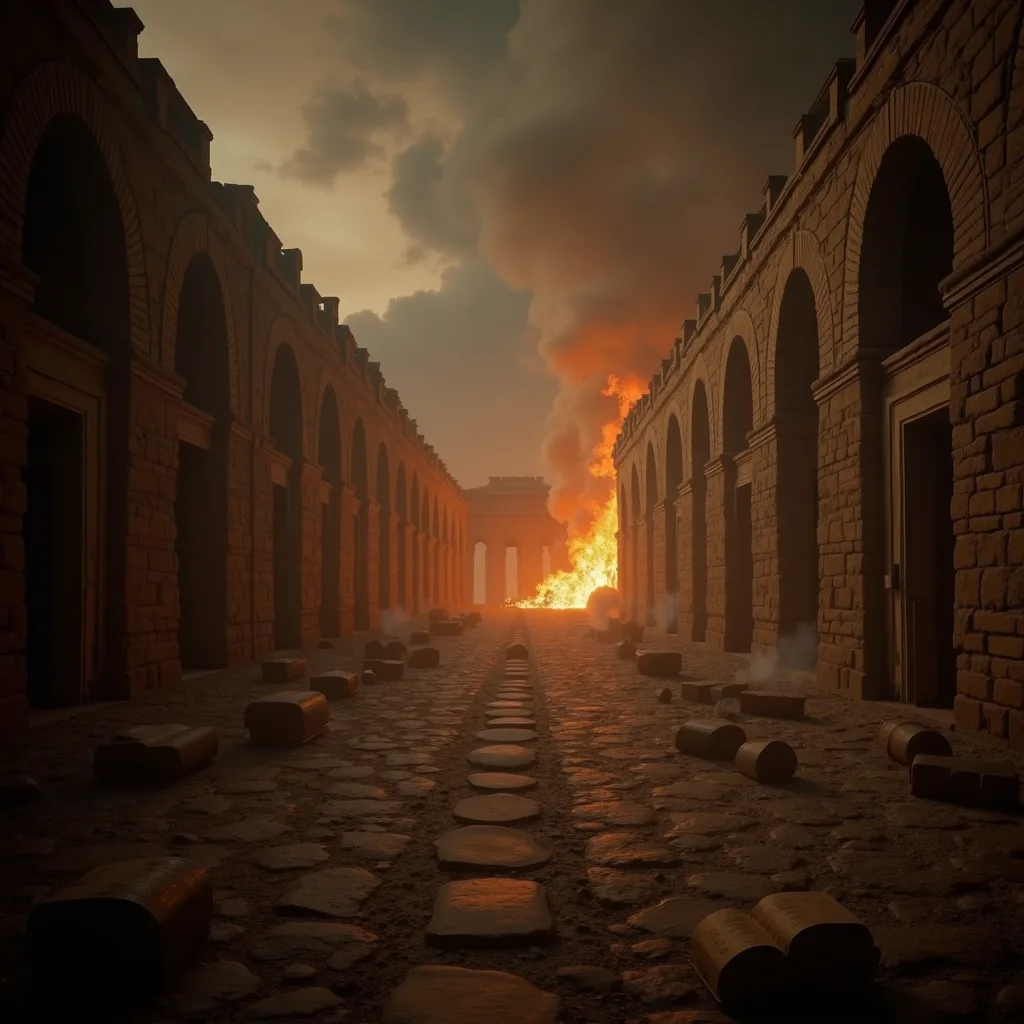
Ask anyone what the greatest intellectual catastrophe in history was, and they'll likely say: the burning of the Library of Alexandria. The story is simple and devastating — humanity's greatest repository of knowledge, set to flame, centuries of wisdom lost overnight.
The only problem is that the story isn't really true.
The Library of Alexandria wasn't destroyed in a single fire. It declined over centuries, through neglect, funding cuts, political upheaval, and a series of violent episodes. And the knowledge it held wasn't unique — much of it existed in copies elsewhere. What we lost was real, but far more complicated than the myth suggests.
What the Library Actually Was
The Library of Alexandria was founded in the early third century BCE by Ptolemy I, one of Alexander the Great's generals who inherited Egypt after his death. It was part of a larger institution called the Mouseion — literally "place of the Muses" — which functioned as a royal research center. Scholars were paid by the state to study there. They had housing, food, and access to an extraordinary collection of texts.
At its peak, the Library may have held 400,000 to 700,000 scrolls — estimates vary wildly because ancient sources were inconsistent. The Ptolemies pursued collection aggressively. Ships arriving in Alexandria were searched for scrolls; originals were kept and copies returned. Emissaries were sent to Athens, Pergamon, and throughout the Mediterranean to acquire texts. The goal was explicitly universal: to contain all knowledge.
Scholars who worked there included Euclid, who systematized geometry; Eratosthenes, who calculated the Earth's circumference with remarkable accuracy; Archimedes (a frequent visitor); and Callimachus, who created the first systematic library catalog. The intellectual output of Alexandria in the third and second centuries BCE was arguably unmatched in the ancient world.
The Many "Burnings"
The myth credits Julius Caesar with destroying the Library in 48 BCE when he set fire to ships in Alexandria's harbor. Fire spread to docks and warehouses. Some books may have been destroyed. But contemporary sources suggest any damage was to a storage facility, not the main Library — and Caesar himself never mentions destroying it, which would have been a significant enough event to note.
Mark Antony reportedly gave Cleopatra 200,000 scrolls from the library at Pergamon as a gift, presumably to replenish any losses. Not the act of a man who'd just destroyed the world's greatest library.
Later candidates for destruction include the Emperor Aurelian's sack of the Brucheion district in 270 CE, the decree of Theophilus in 391 CE (which destroyed the Serapeum, a daughter library), and the Arab conquest in 642 CE. The Arab caliph's alleged quote — "If these books agree with the Quran, they are unnecessary; if they disagree, they are heretical" — is likely apocryphal, appearing centuries after the supposed event.
The truth is grimmer and less dramatic: the Library probably faded away. Funding dried up as the Ptolemaic dynasty weakened. Scholars went elsewhere. The collection stopped growing, then started shrinking. This is how institutions die — not in a single spectacular fire but through slow institutional decay.
What Was Actually Lost
Here's the genuine tragedy: we don't know exactly what we lost, which makes it impossible to fully grieve.
We know some of what's missing. Aristotle wrote 200 treatises; we have about 30. His lost works included dialogues described as beautifully written — the ones we have are lecture notes, not the polished work he intended for public consumption. Euclid wrote on optics and music theory. Eratosthenes wrote a geography and a history of comedy. None survive.
We know there were extensive Babylonian astronomical records, Egyptian medical texts, and Phoenician histories. We have fragments, references, quotes — but not the sources themselves. The missing texts of antiquity represent not just lost content but lost intellectual lineages: chains of reasoning and discovery that simply stop.
What we probably didn't lose: most of what we have. The works of Homer, Plato, Thucydides, and Herodotus survived because they were widely copied and held in multiple locations. The Library's destruction (such as it was) didn't take these with it.
Why the Myth Persists
The burning library is a story we need. It explains an absence — the gap between ancient brilliance and medieval stagnation — as a single catastrophic event rather than the messy truth of civilizational complexity. It gives us a villain (Caesar, Theophilus, the Arabs — whoever fits the teller's narrative) and a clear moment of loss.
More importantly, it expresses a genuine anxiety: that knowledge is fragile. That the accumulated wisdom of centuries can be erased. That civilization is not inevitable but contingent.
That anxiety is correct, even if the specific story is wrong. The Library didn't burn in a night — but knowledge does get lost. Languages die. Oral traditions end with their last speakers. Manuscripts rot in unstored archives. The lesson of Alexandria isn't about a single fire; it's about the institutional will to preserve.
The Library existed because rulers decided knowledge was worth funding. It declined when they stopped. The scrolls survived elsewhere because copyists thought them worth reproducing. What we have of antiquity survived because, in enough places, someone cared enough to copy it down.
The library that burns isn't always the one on fire. Sometimes it's the one no one bothered to maintain.