How the Silk Road Shaped Civilization
This post contains affiliate links. If you purchase through them, I may earn a small commission at no extra cost to you.
The name is misleading. The Silk Road was neither a single road nor exclusively about silk.
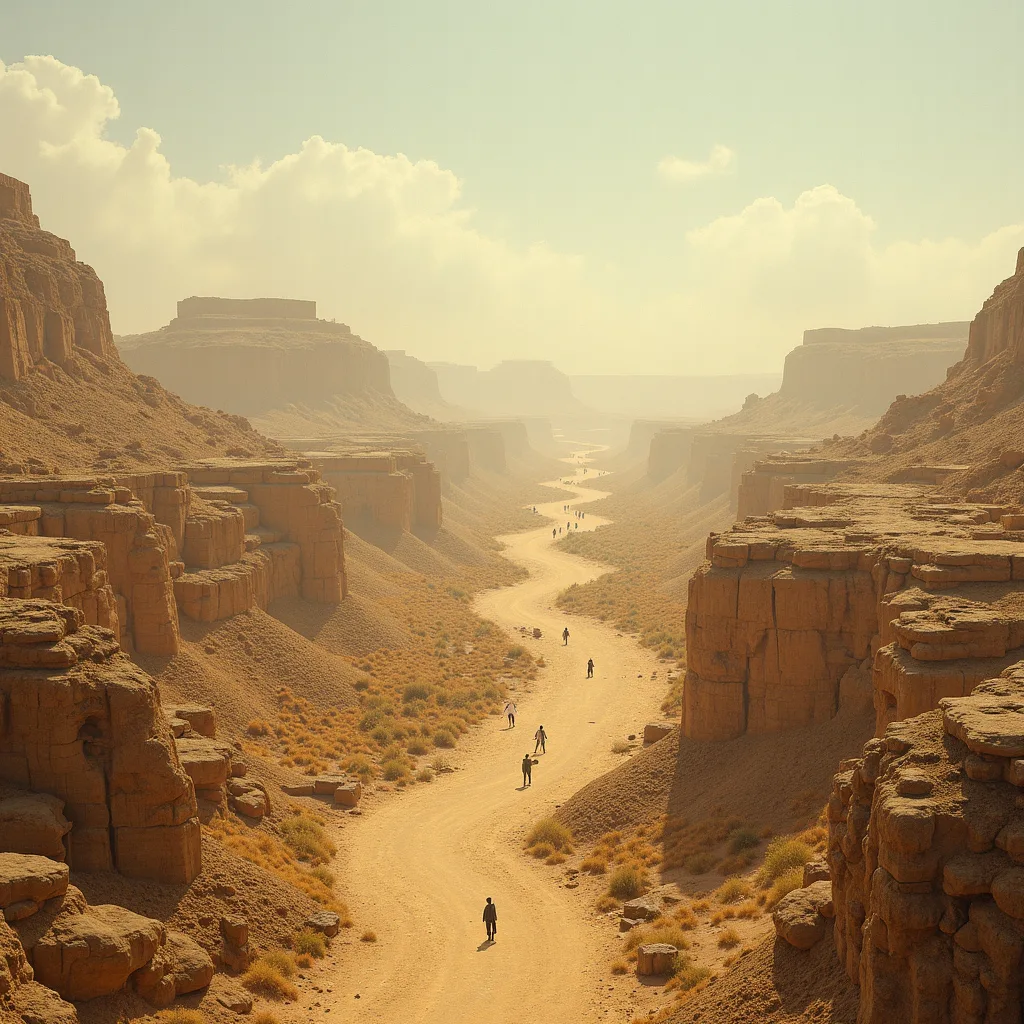
It was a sprawling network of overland and maritime routes — more than 7,000 miles of paths connecting China to Rome, stretching from the Pacific coast to the Mediterranean — and it transported something far more valuable than fabric: ideas.
For over a millennium, the Silk Road served as humanity's first globalization engine. What moved along it reshaped every civilization it touched.
The Network That Connected Worlds
The Silk Road wasn't built. It emerged — from the intersection of supply, demand, and geography. Chinese merchants carried silk westward. Roman merchants craved it. Between them lay Central Asian traders, Persian intermediaries, Indian merchants, and Arab navigators who each took a cut, added goods, and kept the goods moving.
No single person controlled it. No empire spanned its length (though many tried). The Silk Road's power lay in its decentralization — a network of networks, each optimized for its local segment, together creating something that no single actor could have built alone.
This mirrors how modern supply chains work. The logic of distributed networks, with each node adding value and passing goods along, is as old as trade itself. As we explored in how the spice trade shaped empires, whoever controls the chokepoint in a trade network controls the profit.
What Actually Traveled the Road
Silk was the headline cargo, but the manifest was far richer:
Technologies: Paper and printing from China. Glassblowing from Rome. Steel-making from India. Mathematical concepts from Arabia. The exchange wasn't unidirectional — every civilization sent and received.
Religions: Buddhism spread from India to China along Silk Road corridors. Islam followed trade routes across Central Asia, North Africa, and Southeast Asia. Nestorian Christianity reached China centuries before Western missionaries. The movement of faith along trade routes is one of history's most underappreciated forces.
Diseases: The Justinian Plague (541 CE) and the Black Death (1340s CE) both traveled Silk Road routes. Rats on caravans and fleas on rats moved pathogens across continents faster than any human messenger could carry warning. Trade creates prosperity and vulnerability simultaneously.
Artistic styles: Hellenistic sculpture influenced Buddhist art in Gandhara (modern Pakistan and Afghanistan). Persian motifs appeared in Chinese silk patterns. Roman glass ended up in Korean royal tombs. Culture traveled on the backs of commerce.
The Tang Dynasty: Silk Road Zenith
At its peak under China's Tang Dynasty (618–907 CE), Chang'an (modern Xi'an) was arguably the most cosmopolitan city on earth. With over a million residents, it hosted Persian merchants, Arab traders, Japanese students, Tibetan diplomats, Sogdian musicians, and Indian monks. The city's West Market had shops selling goods from dozens of nations.
This cosmopolitanism produced creative explosion. Tang poetry, metalwork, and ceramics absorbed influences from across the known world and synthesized them into something distinctly Chinese but undeniably global. The greatest cultures in history have often been the most porous — the most willing to import foreign ideas and transform them.
Chang'an in 700 CE is a useful corrective to any narrative that civilization flows in one direction. The movement of mathematical concepts across these same routes helped give Europe the tools for its own intellectual revolution centuries later.
The Road as Information Highway
Long before the internet, the Silk Road functioned as an information network. Travelers carried news of political upheavals, military movements, crop failures, and price changes. Merchants shared knowledge of road conditions, bandit activity, and currency exchange rates. Ancient trade networks developed sophisticated mechanisms for transmitting and acting on information at speed.
The Mongol Empire's "yam" postal relay system — which Genghis Khan installed across his territories — could move a message from China to Persia in days. Marco Polo's 13th-century travels were enabled by this infrastructure. The Pax Mongolica, for all its violence of conquest, created the most secure and efficient trade corridor the ancient world had seen.
Why the Road Declined
The Silk Road didn't die suddenly. It was gradually displaced. Ottoman expansion in the 15th century made overland trade more expensive and dangerous. Portuguese navigation around Africa's Cape of Good Hope in 1498 (the same voyage that upended the spice trade) offered cheaper maritime alternatives. Chinese internal politics periodically closed the western gates.
By 1600, the sea routes had won. The Silk Road's trade volume collapsed, its great Oasis cities began to depopulate, and the network that had connected civilizations for a millennium faded into desert archaeology.
But its legacy persists. Every time a mathematical idea from one culture solves a problem in another, every time a food travels its origin culture's borders and becomes a global staple, every time trade creates cultural contact that produces something neither culture could have made alone — that's the Silk Road's inheritance.
What It Teaches
The Silk Road's deepest lesson isn't about trade. It's about the compounding returns of connectivity. The civilizations that sat on its nodes didn't just get richer — they got smarter, more creative, and more adaptable. Isolation preserves cultures in amber. Connection evolves them.
Every era has its Silk Road — the dominant network through which ideas, capital, and talent flow. Understanding which network matters most, and how to position yourself on it, is as strategically important today as it was in 200 BCE.
The road didn't just connect cities. It built civilization.